

Across the environmental industry, “thermal” methods are often grouped together. Yet incineration and thermal desorption, while both use heat, are fundamentally different technologies with very different goals, controls, and environmental outcomes.
Understanding these distinctions is essential, especially as regulators and project managers seek reliable solutions for per- and polyfluoroalkyl (PFAS)-contaminated soils and other complex waste streams.
Incineration: Complete Combustion for Bulk Waste
Incineration is a high-temperature oxidation process that combusts waste directly, typically above 1,000°C, converting it to ash, flue gas, and heat. It is designed for bulk destruction of materials such as municipal solid waste, medical waste, and concentrated hazardous waste. While incineration can destroy many contaminants, it has notable limitations when applied to soils with low-level PFAS contamination:
- Combustion of large soil volumes is inefficient and energy-intensive.
- Soil mineral content reduces combustion efficiency.
- Stack emissions require advanced scrubbing to manage particulates and volatile compounds.
- PFAS degradation can be expensive, slow and incomplete without precise residence times and air-flow control.
- PFAS degradation can also produce an ash which requires secure landfilling.
Incineration is, in essence, a mass-burn process, effective for some wastes, but not engineered for selective contaminant removal within soil matrices.
Thermal Desorption: Controlled Separation and Targeted Destruction
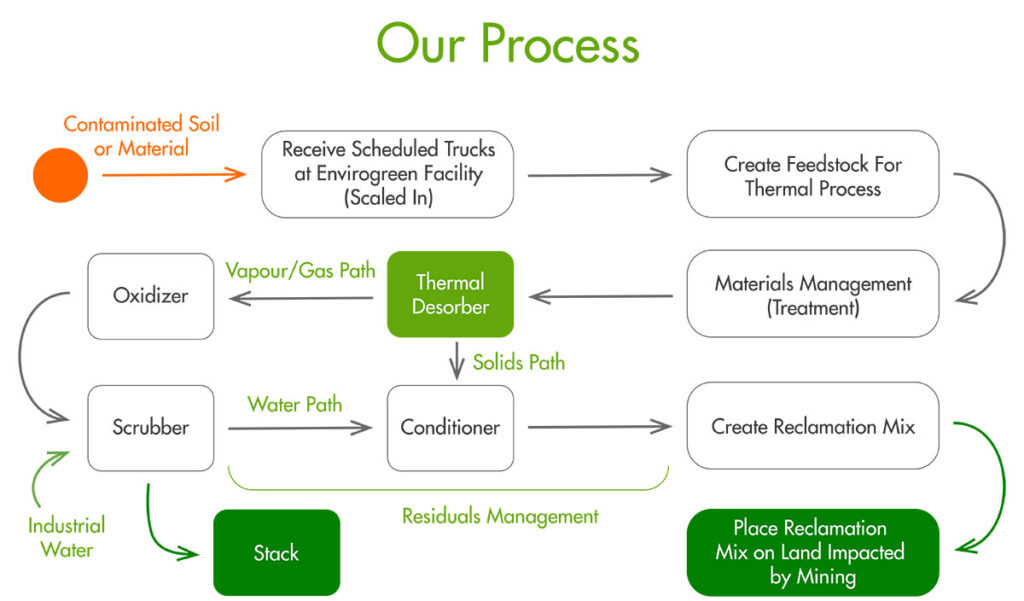
Thermal desorption is a treatment process, using combustion. Contaminated soil is heated directly – typically between 400°C and 480°C – to separate volatile and semi-volatile compounds from the soil matrix.
Those separated compounds are then directed to a secondary destruction chamber operating at higher temperatures, where complete breakdown occurs under controlled oxygen and residence-time conditions.
This method is ideal for soils containing:
- Hydrocarbons and Polycyclic Aromatic Hydrocarbons (PAHs)
- Low-level chlorinated organics like pesticides
- Trace PFAS compounds
In PFAS-impacted soil, the thermal desorption process targets, removes and breaks down the trace PFAS molecules adsorbed onto soil particles, converting them into non-hazardous components through controlled oxidation. The treated soil itself is not burned and converted into ash for long-term deposit into a landfill, instead, it is cleaned and available for beneficial reuse.
Key Differences at a Glance
| Feature | Incineration | Thermal Desorption |
|---|---|---|
| Process Type | Direct combustion of waste | Direct heating and separation of contaminants |
| Temperature Range | 1000–1200°C | 400–480°C (primary), >1100°C (secondary) |
| Material Treated | Municipal solid waste, medical waste, concentrated hazardous waste | Soil, sediment, solids, sludge, filter media |
| Soil Integrity | Destroyed (ash remains) | Preserved and reusable |
| PFAS Application | High concentration destruction | Trace PFAS removal in soil |
| Output | Ash, flue gas | Clean soil, treated air stream |
| Environmental Control | Requires treatment and disposal | Used back in treatment system |
| Treatment Cost | Typically more expensive | Less expensive while still providing destruction |
Thermal desorption offers a targeted and accountable approach, reducing contaminants while maintaining soil structure and minimizing emissions.
The Accountability Advantage
For waste generators and environmental consultants, the distinction is not only technical, it is regulatory. Incineration transfers responsibility to a high-temperature facility with limited soil recovery potential where liability remains in the ash stored in a landfill long-term. Thermal desorption, on the other hand, documents each step of treatment: waste profiling, temperature verification, emissions control, and treated material analysis.
This level of traceability supports audit-ready documentation and demonstrates measurable environmental accountability – two growing priorities in the age of ESG transparency.
Why Method Selection Matters
Choosing between incineration and thermal desorption depends on the material type, contaminant profile, and project objectives.
For trace-contaminated soils, thermal desorption provides a balance of:
- Verified contaminant destruction
- Lower energy consumption
- Reusable soil output
- Comprehensive process documentation
In short, it closes the accountability loop, turning complex waste challenges into recoverable outcomes.
Building Confidence in Responsible Treatment
Environmental responsibility does not end when soil leaves a site. Whether managing hydrocarbon-impacted or PFAS-contaminated soils, selecting a treatment pathway that ensures verified destruction and soil recovery is the foundation of sustainable practice.
Organizations evaluating remediation options should consider how each thermal method aligns with project goals, accountability requirements, and future land use.
Leadership in compliance lies in understanding not just what destroys contamination, but how it is done, and what remains afterward.